Workington is town of (currently) more then 20,000 residents located on the Irish Sea coast of Cumbria (formerly “Cumberland”), a short train ride from Carlisle and Scotland. It’s on the western edge of the legendary mountains of the “Lakes District” which is now a national park in the northwest corner of England. The western edge of Hadrian’s Wall started not far from Workington which has something of a Roman history as well. The town sits at the mouth of the river Derwent but back from the actual shoreline where a number of railyards, warehouses, and a small port separate the town center from the sea.
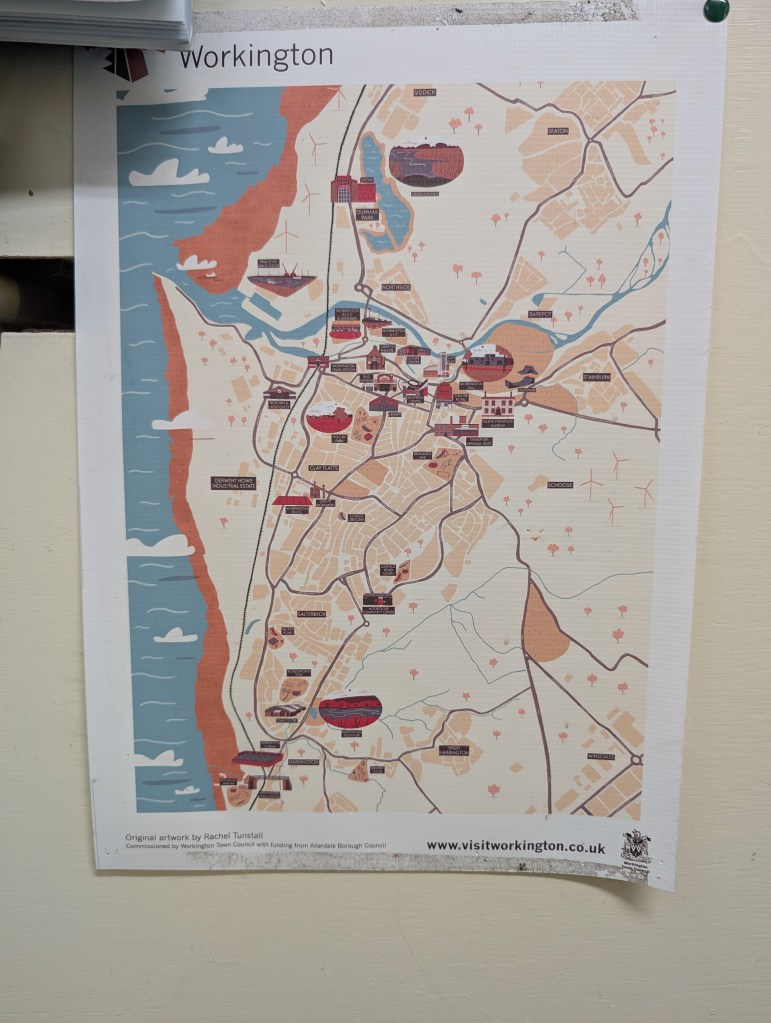
Before the Industrial Revolution Workington was a small port and fishing village, but the Cumbria iron-ore fields to the south produce extremely high grade phosphorus-free haematite which contributed to its industrial heyday. Along with the nearby coal deposits Workington became a steel making town early on, Workington rails were widely exported and it was locally stated that Workington rails “held the world together.”
Our Rector ancestor, Mary Tiffin, left Workington at the dawn of the Industrial Revolution, and (significantly) in 1783 at the age of 15 with her parents and her brothers. They were possibly interested in the possibility of owning land in the New World, but also in the idea of religious freedom promised by the new country. In fact, Mary’s brothers were involved in the establishment of a new Protestant movement called the Methodist Episcopalian Church (MEC) once they arrived in Ohio. More on Mary’s journey, and her family, is posted elsewhere.
Alison and I arrived in Workington from Carlisle after a 45 minute train ride down the coast. Confused about how to exit the station, we entered the station gift shop instead, and Alison struck up a conversation with the attendant who was immediately curious as to why we were visiting Workington. Callum, a self-identified ‘trennuhd’ who was tending the giftshop, was very happy to tell us all about the history as he knew it. He was joined mid-lecture by Sue, a retired physical therapist in her 70s, who felt the need to remind/teach Callum that the unions were actually good for the steel and coal workers, and that Thatcher’s crushing them did more to harm their community than the unions ever did. Callum’s passion is trains and he lamented the earlier effort by a Dr. Beeching’s report eliminating many train lines all over Britain, but specifically the STEAM (at the time) line from Workington to Penrith via Cockermouth and Keswick: “Eemahjin wot th’TOORism in toan would beh lahk eef thet trehn wuhr stull roonnin?!?” Indeed, the route runs through the heart of the beautiful and famous Lakes District, and if it was still STEAM powered, it would be the pilgrimage destination of train nerds from around the world.

Eventually Callum asked: “Did you know we also had our own ‘Nine Mile’ incident in the 1950’s? What was your famous accident — Three Mile Island?” He and Sue then told us about what is officially known as The Windscale Fire south of Workington at a site called Sellafield which was involved in nuclear energy and weapons research. “They told us we were safe,” Sue said, who lived through the 1957 accident, “and we believed them.”
Despite a litany of disappointments recounted by these two Workingtonians, they still reflected a passionate affection for their town and the region. Both Callum and Sue agreed that there are many ‘Tiffins’ still in Workington, including a memorable teacher of Callum’s. They agreed the Labor governments of the 90s were hardly better than the Torys: “The were Labor in name, but not socialists.” They also agreed that “Butterflies” was the best British food in town, Callum told us that “Spoons” was his favoUrite restaurant in town.
As we said goodbye, Sue (who had just dropped off her son who was beginning his return journey to his job and family in CHINA) offered us a ride to the central cemetery where I could start looking for Tiffins. It was a more modern cemetery than our ancestors — few of the burials were before 1900, but it happened to be a good spot to begin a walk to “Butterflies” for a mid-morning Saturday breakfast.

Butterflies was a lovely cafe at the top of the shopping area that was bustling on this Saturday. I ordered a “Full English” that came with everything BUT black pudding (few of them do these days). And Alison ordered a scone and was asked if she’d like some “cream” with it. “Do you mean in a pitcher so that I can pour it over?” She asked. “No, in a heap for you to spread onto the scone,” the waitress replied (in a Cumbria accent much like Colum and Sue’s, of course). *Clotted* Cream in these parts is just “cream” apparently. Alison said yes, and was delighted that she did.
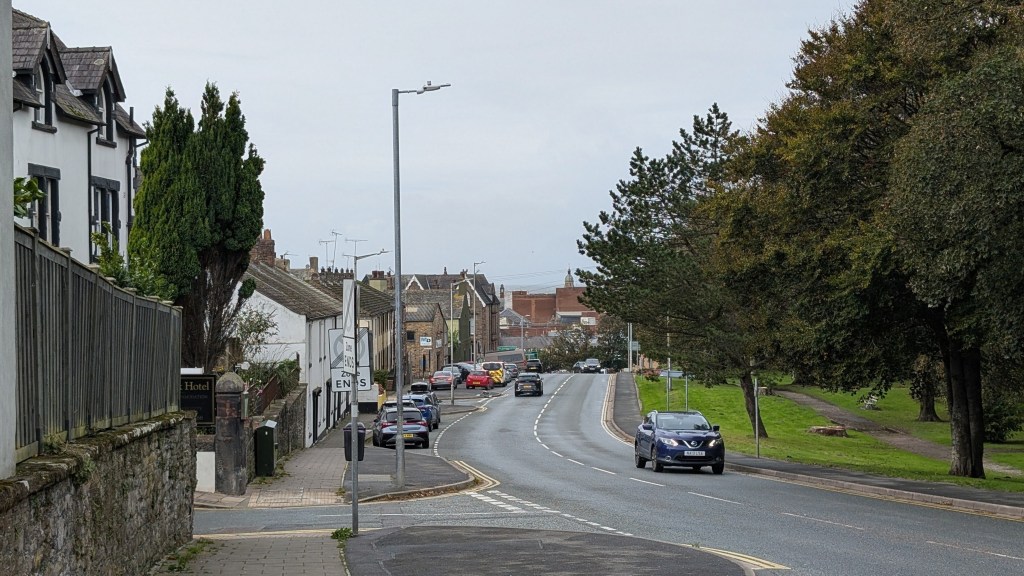
From the restaurant we walked uphill to visit “Stainburn” which is a little “village” on the edge of Workington that several of the records identifying our Tiffin relations in Workington mention, so it’s likely that they lived there. I was simply curious to see what was there. Today it’s very residential with mini-manses lining both sides of the main street leading up to a cross-roads where an old Inn sits. All the houses looked quite posh, with BMWs, Landrovers, and Mercedes parked in front of them — now I’m curious about where this money is coming from given the economic plight of the region described by Sue and Callum. Also, the Inn happens to be for sale for anyone interested in making a reverse migration to their ancestral roots. Hasn’t Uncle Tom always wanted to run his own British Pub some day?

Heading back down the hill we had views over the town and out to the sea, which was churning solid green with whitecaps that day because of “Storm Amy” blowing past us, mostly to the north, but still responsible for flight/train cancellations and delays. It was blowy while we were out walking (I wouldn’t have called it ‘gusty’), and the rain would come and go quickly, and luckily not that often as we had a relatively dry day. On our way down we had hoped to stop into the local “Helena Thompson Museum” for more information about the town, but it was closed for a private event that weekend (it advertised itself as a wedding venue on it’s sign!), so we could browse only a few bits out front, which included examples of their famous train rails, and a few other objects of interest that did not, perhaps, fit inside the museum itself.

On our way down through the shopping district we discovered a Carnegie Library (like many that had been built in Maine!) that has been converted into a theatre (“Only the SECOND Carnegie theatre in the world!” according to another young male Workington booster who volunteered there. “The only other is in New York City…”). The main room on the ground floor is now a cafe and pub, and it seemed well used when we were there.

Our guide also took us over to a plaque commemorating the moment when the Birmingham based band “Earth” changed its name to “Black Sabbath” at a music venue in Workington.

Further downhill from the shopping area we past the Old Trades Hall where Sue’s father, a proud union carpenter, used to spend the time he wasn’t out working on jobs. Then we got to St. Michael’s church at the bottom of the hill, near the train station. This church is also mentioned as a baptism spot for several of our Tiffins, so it seemed reasonable that I might find some gravestones related to us.

As is the case with some other English churchyards I’ve visited, the gravestones no longer stood above grave sites, but had been moved to lean against the enclosing walls, probably because they’d been knocked down and broken so many times in the past.

Many of the stones were from the 1800s, and a few were even from the late 1700s, but no Tiffins whatsoever, alas.
With that we walked the remaining few blocks to train station. Alison bought an extra scone to give to Callum in the gift shop as a token of our thanks for being one of our guides. He really seemed to appreciate it, happy to tell the story of Workington to people who seemed genuinely interested. It was late afternoon as we waited for the next train heading back to Carlisle, and all around us were young couples obviously heading into “the City” for a Saturday night out. I already mentioned “Storm Amy” and the wind, and the rain, but perhaps I didn’t mention that the temperature was barely in the 50s (Fahrenheit)? And almost every single one of the lasses was dressed in showy skimpy dresses and tops, the lads in designer tee-shirts, and hardly one of them seemed willing to wear a coat over their party wear! I was amazed, as I was with our whole trip to Workington.

 RectorSite