
The 54th San Francisco International Film Festival will run through May 5, featuring 192 films. Carol and I will be going about every day, sometimes to the same film, sometimes to different films. I will write capsule reviews of the films I see and post them here as soon as I get them written. The most expeditious way to do these reviews, for me, is to take the advance blurbs and edit them, then add MY TAKE. If you’re interested, you can see the advance blurbs at the SFIFF54 web site.
DETROIT WILD CITY
Fri, Apr 29 7:00 / Kabuki
Detroit ville sauvage, Documentaries, France/USA, 2010, 80 min, in English
director Florent Tillon
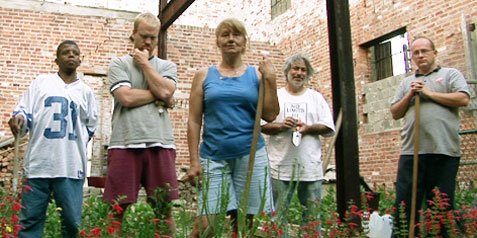
Florent Tillon’s film begins with familiar but inevitably arresting images of Detroit’s decay into postapocalyptic pastoralism, but doesn’t end there. While most cinematic pilgrims have portrayed the Motor City as a giant canvas onto which they project their outsider fantasies, Tillon has greater ambitions and greater respect. The obligatory urban tour of empty factories and the abandoned Michigan Central station quickly gives way to a contemplative, nuanced discussion of what futures might actually be possible. As we visit with a variety of Detroiters, we realize that most of what we think we know about Detroit is superficial, and begin to question easy assumptions about urban agriculture, urban pioneering and Detroit’s reversion to a “natural” state. While urban farmer Shirley Robinson suggests “a lot of people would go back to a simple life if they had a choice,” outsider historian/pundit Black Monk questions the long-term effect of today’s urban pioneering movement. “Urban pioneers find the edge, but don’t occupy it,” he tells us. “Cities are built by settlers, not pioneers.” Tavern proprietor Larry Mongo, on the other hand, likens today’s young inbound migrants to those who originally settled Detroit 300 years ago. A minimalist but intelligent travelogue that resists sensationalism, Detroit Wild City focuses on people rather than ruins. It suggests that while macronarratives may help us understand the past, micronarratives will describe the future, and Detroit’s destiny will be the product of many individual, small-group and localized efforts.?—Rick Prelinger?
MY TAKE — When I think of Detroit as a ruin, I think of Michael Kenna’s book, The Rouge, photographs of the Ford assembly plant, shut down. Still and stately black and white photographs of a time passed. I also think of the photographs of Bernd and Hilla Becher, though their many books of photographs of industrial facades do not include Detroit.
I’m not sure what Florent Tillon set out to do with Detroit, but as I see it, she produced a rich photographic essay: a thriving urban center gone bad and forming not ruins, but majestic shells of brick and concrete. To this, she added soul, formed in stories by individuals — whether the urban Mr. Fixit, the sideburned gentleman who loved to walk the ruins, or one or more philosophers — their rather unconnected narratives do suggest that Detroit lives, it did not and will not die. Cue the fireworks.

KANBAR AWARD: FRANK PIERSON
An Afternoon with Frank Pierson Saturday, April 30, 12:30 pm?Sundance Kabuki Cinemas?1881 Post Street (at Fillmore)
Frank Pierson is the recipient of the Kanbar Award for excellence in screenwriting at the 54th San Francisco International Film Festival. An onstage interview about his 50 years in the business will be followed by a screening of Dog Day Afternoon, a gripping, nuanced film directed by Sidney Lumet, about a heist gone wrong, that garnered an Academy Award for Pierson.
A former Time magazine correspondent, Pierson began his screen career as a story editor, and later producer/director, on the popular CBS TV series Have Gun Will Travel in the early 1960s. He also wrote for Studio One, Alcoa Goodyear Theater, Route 66 and Naked City, popular series during the so-called Golden Age of Television. Continue reading “SFIFF54 Our Second Week” →









 RectorSite