
Before we traveled to China, I used to tell people that the most “exotic” place I had ever visited was Israel and the Sinai desert because, although there were familiar elements (especially in Israel), I really felt we were on the doorstep of Asia and another way of living from what I knew. I looked forward to visiting China to finally step across that threshold and begin to understand another culture. Shanghai, despite it’s sky scrapers and fast food restaurants, granted my wish, and more. But more than two thousand miles later I felt on the edge of yet another threshold, to what I could not imagine, yet something was palpably *there* beyond what I had already learned about China in our short stay. Am I that far removed, I thought to myself, from understanding how large portions of mankind live? If so, how do I best describe Kashgar?
First, it is in the center of Central Asia : at the western edge of China where Xinjiang Province meets Kazakhstan, Tajikistan, Kyrgyzstan, Uzbekistan, Afghanistan, Pakistan, and the Kashmir region still being fought over by Pakistan and India. It’s as close to the Mediterranean Sea as it is to Beijing. It’s an ancient Silk Route trading post on the western edge of the Taklamakan Desert that separates it from the rest of Xinjiang Province where travelers stopped to prepare for their dangerous trek around this most forbidding obstacle separating the riches of the West from those of the East, or where they stopped to celebrate a successful crossing from the East. It retains the spirit of being an important hub where the world comes to buy, sell, and barter. The city’s graphic symbol is the pomegranate tree, and it’s a wellspring of the Uighur culture where they still make important Uighur products — knives, water kettles, lace hats, string instruments, silk fabrics — by hand, and grow and process much of their favorite foods in the surrounding small farms where 90% of the 3.5 million residents of the Kashgar prefecture live. While Turpan showed some direct Han influence on the Uighur people, the only recognizably Han part of Kashgar was a giant statue of Mao overlooking the main square.
We arrived with little knowledge of the city, only snippets (a *fascinating/hilarious* link!) that we had read about on the web, and the bare list of sites we would visit in our trip itinerary. Most of what we knew about the area came from “Beyond The Great Wall” where Duguid and Alford mention it only as a jumping-off point for their bike ride (!) to Pakistan via the newly opened Karakorum Highway linking Kashgar to Islamabad. The one recurring note was that we must visit the Kashgar Sunday Market…
Continue reading “Doorstep To The Moon” →
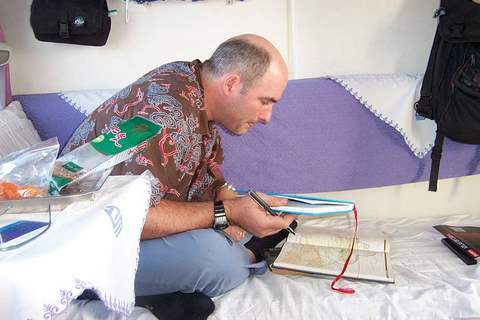
 We had an early morning flight out of Urumqi (pronounced “Oo-Room-Chee”), and four and a half hours after takeoff we landed in the other Shanghai airport — Hongchiao — north of the city center. We got instructions on which bus would take us to the Metro, and we easily found our way back to Patrick and Tina’s apartment in the western French Concession. Patrick was there to greet us and wanted to hear all about our adventures but careful not to let us get too carried away because Tina would want to hear all about it as well later at dinner.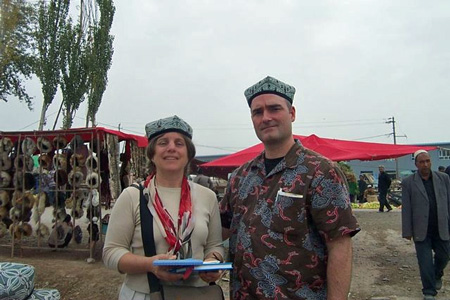

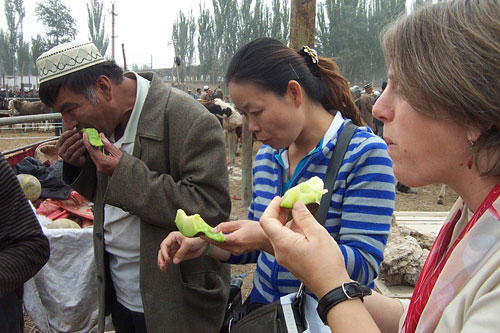
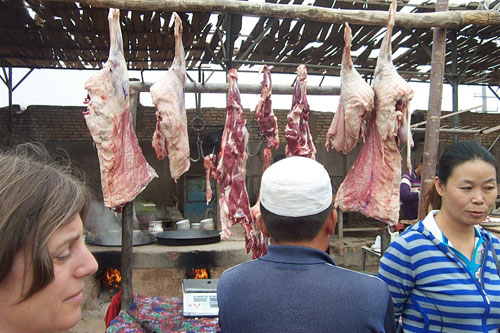

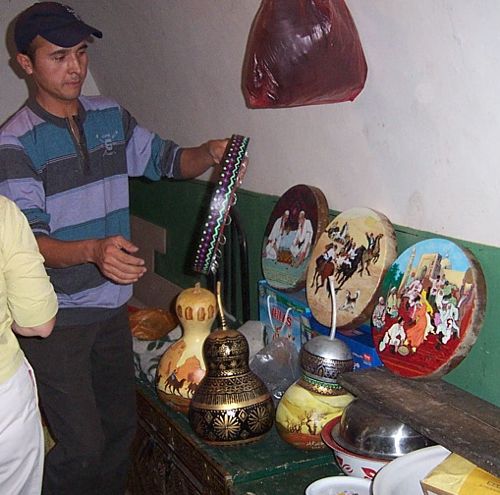

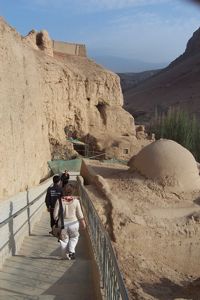 The next morning we met Ahmad and Mr. Chou at the breakfast buffet (Ahmad had melon, Mr. Chou a bowl of “gruel”), then checked out of our hotel on schedule at 9am and piled into the minivan. “After dinner Mr. Chou spent two hours last night in line at the only open gas station in Turpan right now,” Ahmad explained. “This is one more thing that frustrates me: Xinjiang provides China with 35% of it’s oil and natural gas, and yet the people of Xinjiang benefit very little from it.”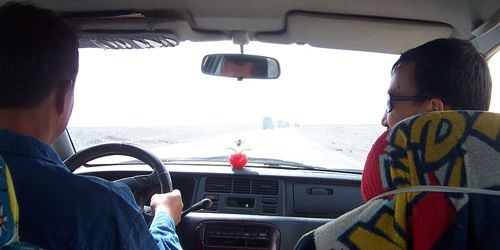

 Long before we left for China we did a lot of reading about China, and it became clear to us that the country is enormous and varied and that if we stayed in Shanghai for our two week trip we would be seeing a tiny slice of what is called “China.” One of the books that piqued my interest in “the rest of China” was
  RectorSite
