Doorstep To The Moon

Kashgar_map

Before we traveled to China, I used to tell people that the most “exotic” place I had ever visited was Israel and the Sinai desert because, although there were familiar elements (especially in Israel), I really felt we were on the doorstep of Asia and another way of living from what I knew. I looked forward to visiting China to finally step across that threshold and begin to understand another culture. Shanghai, despite it’s sky scrapers and fast food restaurants, granted my wish, and more. But more than two thousand miles later I felt on the edge of yet another threshold, to what I could not imagine, yet something was palpably *there* beyond what I had already learned about China in our short stay. Am I that far removed, I thought to myself, from understanding how large portions of mankind live? If so, how do I best describe Kashgar?

First, it is in the center of Central Asia : at the western edge of China where Xinjiang Province meets Kazakhstan, Tajikistan, Kyrgyzstan, Uzbekistan, Afghanistan, Pakistan, and the Kashmir region still being fought over by Pakistan and India. It’s as close to the Mediterranean Sea as it is to Beijing. It’s an ancient Silk Route trading post on the western edge of the Taklamakan Desert that separates it from the rest of Xinjiang Province where travelers stopped to prepare for their dangerous trek around this most forbidding obstacle separating the riches of the West from those of the East, or where they stopped to celebrate a successful crossing from the East. It retains the spirit of being an important hub where the world comes to buy, sell, and barter. The city’s graphic symbol is the pomegranate tree, and it’s a wellspring of the Uighur culture where they still make important Uighur products — knives, water kettles, lace hats, string instruments, silk fabrics — by hand, and grow and process much of their favorite foods in the surrounding small farms where 90% of the 3.5 million residents of the Kashgar prefecture live. While Turpan showed some direct Han influence on the Uighur people, the only recognizably Han part of Kashgar was a giant statue of Mao overlooking the main square.

We arrived with little knowledge of the city, only snippets (a *fascinating/hilarious* link!) that we had read about on the web, and the bare list of sites we would visit in our trip itinerary. Most of what we knew about the area came from “Beyond The Great Wall” where Duguid and Alford mention it only as a jumping-off point for their bike ride (!) to Pakistan via the newly opened Karakorum Highway linking Kashgar to Islamabad. The one recurring note was that we must visit the Kashgar Sunday Market…
Continue reading “Doorstep To The Moon”
Osman

osman_drums

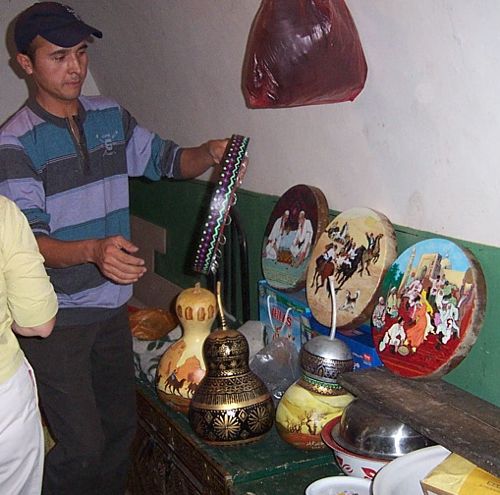
As we drove out of Turpan on our way to the ancient ruins of Jiaohe when our guide in Turpan, Ahmad, learned in conversation that Alison was an artist, he got a twinkle in his eye and said, “I have a friend who is an artist — perhaps you would like to meet him and see his work?” “Yes!” Alison responded with curiosity. “Good! I will arrange it then.”
Continue reading “Osman”

Raisins In The Sun, 2

Entrance to the Thousand Budda Caves tourist site

Chapter 2
(Go to Chapter 1)

tbc_walkwayThe next morning we met Ahmad and Mr. Chou at the breakfast buffet (Ahmad had melon, Mr. Chou a bowl of “gruel”), then checked out of our hotel on schedule at 9am and piled into the minivan. “After dinner Mr. Chou spent two hours last night in line at the only open gas station in Turpan right now,” Ahmad explained. “This is one more thing that frustrates me: Xinjiang provides China with 35% of it’s oil and natural gas, and yet the people of Xinjiang benefit very little from it.”
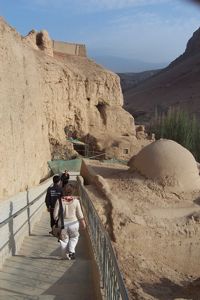
We turned onto the main highway and headed east away from Turpan back into the desert with the Flaming Mountains to our left glowing in the early morning sun. Half an hour later we turned left and headed into gap in the mountains, winding our way up the back sides until we stopped in a newly built but empty parking lot. We were handed tickets, presented them to bored attendants (who had been playing basketball when we pulled up), went through the turnstiles (“Sheh sheh.”) and then followed Ahmad down a stairway. After descending for a few minutes we came around a sharp turn and saw a series of caves up and down the hillside with stairs leading to each one from a main plaza.
Continue reading “Raisins In The Sun, 2”

Raisins In The Sun, 1

chou_ahmed

(Click here to see our Picasa album of this story.)

Dawn was late.

We woke at 7am in the Huozhou Turpan hotel (“four star!” according to our tour guide) and it was still dark out, barely a hint of light in the eastern sky, where the sun didn’t appear until 8am. Our room overlooked the only lake in the Turpan region, an artificial pond surrounded by cement in a park in the center of the city. Dominating the skyline across the pond was the Tuha Petroleum Hotel, the only “five star” hotel in Turpan, and also the offices of the region’s largest commercial employer Sinopec.

huozhou_hotel_roomOur room was pretty nice despite the rock hard beds (like barely padded plywood on top of some springs); it would compare well with any quality hotel room in the US, which thankfully meant a western pedestal toilet. (I think “four star” really means “private bathroom with shower and pedestal toilet.”) The buffet breakfast was Han Chinese — corn porridge (labeled “Gruel”), stir-fried vegetables and/or noodles, bao buns, and lots of sliced fruit — disappointing only because we had loved the Uygar dinner last night and looked forward to more of it. But that would come.
Continue reading “Raisins In The Sun, 1”

Two Day Train

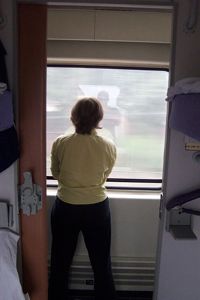
train_view2Long before we left for China we did a lot of reading about China, and it became clear to us that the country is enormous and varied and that if we stayed in Shanghai for our two week trip we would be seeing a tiny slice of what is called “China.” One of the books that piqued my interest in “the rest of China” was Beyond The Great Wall a cookbook-travelogue by the couple Naomi Duguid and Jeremy Alford who wrote the James Beard Award winning book Hot Sour Salty Sweet. Their point is that there are many culinary worlds within China, even without making distinctions between Hunanese, Cantonese, Sichuanese etc. They describe, in recipes, photos, and stories the world of food outside the Han culture that dominates so much of China.

As I read about these tantalizing destinations I began to think — how could we best experience the breadth of China despite having only a free week after our adventures in one of the world’s largest cities? I had heard that airplane flights are now numerous and cheap within China, but hop-scotching across vast amounts of land, even with a good window seat and good weather really can’t give you a sense of the land. Driving in a car was out of the question (all of the street signs in Shanghai are in English and Chinese, but no where else in the country (besides Beijing and Hong Kong) would this be the case, but what about the train?

[View the Picasa album here.]
Continue reading “Two Day Train”

Everything Old Is New Again

Montana Territory 1879

We are headed to Xinjiang, which is kind of like traveling to Montana 130 years ago in almost every possible way. One of the similarities, we’ve been told by folks who’ve just arrived from out yonder, is that there is currently no digital communication available in the entire province. Therefore, in contrast to the constant blogging of our adventures in Shanghai where digital communication has been easy and plentiful, we do not expect to be able to update you’ns in these pages until we return to our home on the range in Maine.

Thanks for reading up to this point. We hope we remember enough to fill you in on the second week of our trip after we return.

A Meal To Remember

800px-RedCookedPorkBellyAt 99 Fuxing Lu (an older restored home in the French Concession now offering “true” Shanghai cuisine); following is the menu with some translation help from our friend Patrick who set it up:

  • River Eels with Asparagus
  • Drunken Chicken (Zuiji in Mandarin, stewed chicken over ice)
  • Kaofu in Sauce (Kaofu, braised wheat gluten with wood ear mushrooms and “golden needles”)
  • Fried Smoked Blue Fish (Xunyu, but not the blue fish we know in America, more like a firm white fish)
  • Braised River Shrimp (He Xia, braised in a very light sauce and served by themselves)
  • Stir-fried Greens (Mixian)
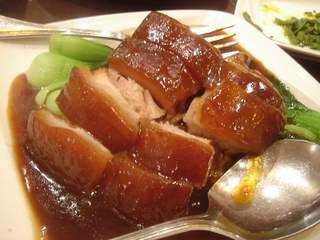
  • Red-cooked Pork (Hong Shao Rou, Braised Pork Belly or Pork Leg, ours was the belly)
  • Eels in Brown Sauce
  • Braised Shad (this could have been a true Shad, and the fish was cooked qing zhen, or steamed with ginger, scallion and a sauce of oil, soy, sugar and shaoxing wine)
  • Fish Stomach Soup (Lao Ji Tang, chicken soup with fish stomach and winter melon)
  • Lions Head (a light but large pork meatball, ours was served in a broth, but it’s never called soup because it can be served in a variety of context)
  • Noodles with Fried Chives and Dried Shrimp
  • Fermented Rice with Black Sesame Dumplings (Niang Mi Zhima Tang Yuan)
  • Fruit (Shuiguo, we had watermelon – Xigua)

Continue reading “A Meal To Remember”