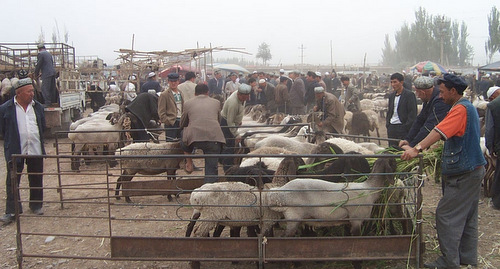
Don’t Take My Word For It

Here’s an excellent overview of the Uighur situation by the NY Times, which concludes that through its heavy handed repression of the Uighur population in Xinjiang, the Chinese government “could unwittingly radicalize a generation of young people, said Nicholas Bequelin, a researcher for Human Rights Watch who is based in Hong Kong. ‘The entire Uighur ethnicity feels asphyxiated, having become suspect as sympathetic to extremism,’ he said. ‘Xinjiang is trapped in a vicious circle of increased repression that only leads to more violence.'”

I wonder, however, if the Chinese government’s efforts are the opposite of “unwittingly” because as soon as there is a violent incident that is indisputably linked to a Uighur resistance group, the government will then have “license” to wipe out all but a few token Uighur communities, and their assumption of this HUGE region will be complete, claiming outright their only petroleum reserves and an increasingly crucial trade link to the rest of Asia and Europe.

Turpan Story

——–

The wirey man in the small room did not sit at a desk, but stood at a small metal stand — perhaps a music stand? – holding paperwork and my and Alison’s passports. He seemed young – smooth faced, long and lean, almost feline – but it’s often difficult for me to estimate age in Han men. He wore an all black uniform along with a black cloth baseball cap that had a short brim and Chinese characters stitched into the front.

“What is your name?”

“Eric Rector?” I replied as a question, obviously nervous.

“What is the purpose of your visit?” He had not yet looked at me, and continued working through the paperwork on his stand whether I replied or not. Perhaps he was filling in the blanks of a Rural Village Visa application, I wasn’t sure.

“I am touring Turpan for pleasure.” I said using the terms available in the list of options on the imagined visa form.

He laughed, which did not make sense because I’m sure he wasn’t reading any irony into this situation. My host family had tried to register our visit to their home with the village police, and the local police wanted nothing to do with us. They insisted that my hosts call the city police and follow their lead. In the village station my host called and was told: bring them to the city headquarters – we want to talk to the visitors. We also want them to check into a hotel in the city; there are not adequate facilities for them in your village.

“What is the purpose of your visit to _____ Village?” he clarified.
Continue reading “Turpan Story”

Writing Behind “The Great Firewall”

Image provided by gorancson.wordpress.com and/or lostlaowai.com

We have returned from our trip to China, and I expect we will be processing our experiences for many weeks and months to come — stay tuned. We are also taking advantage of the long Labor Day weekend to re-acquaint ourselves to our normal lives, which somehow seem just as foreign to us as our first days in Beijing, Xinjiang, or Chengdu.

One item of note that bears immediate reflection, however, is how difficult it was to even report our experiences to the RectorSite while we were in China even though we had Internet access almost everywhere we traveled except for the small towns in Xinjiang province. As we generally stayed in “Four Star” hotels (or better) catering to travelers — particularly Westerners — I can only explain this difficulty to the massive effort the Chinese Government continues to make to *FILTER* the Internet. The Chinese Government recognizes that they NEED the Internet to facilitate economic exchange with the rest of the world, and that it would be foolish as well as a public relations black mark if they completely disconnected their citizens from this worldwide network of ideas. However they really dislike it when their citizens are exposed, and/or are allowed to talk about certain ideas. Therefore they have constructed a “Great Firewall / Golden Shield Project” that sniffs out those ideas in all traffic within their borders — either entering the country from outside sources, or generated internally — and deletes them.
Continue reading “Writing Behind “The Great Firewall””