
Alison posted a good rundown of our guided tour through the memories of an ex-pat Shanghailander (as they call themselves), but I wanted to add one more important aspect of what we saw.
Continue reading “More Monday Memories”
Alison posted a good rundown of our guided tour through the memories of an ex-pat Shanghailander (as they call themselves), but I wanted to add one more important aspect of what we saw.
Continue reading “More Monday Memories”
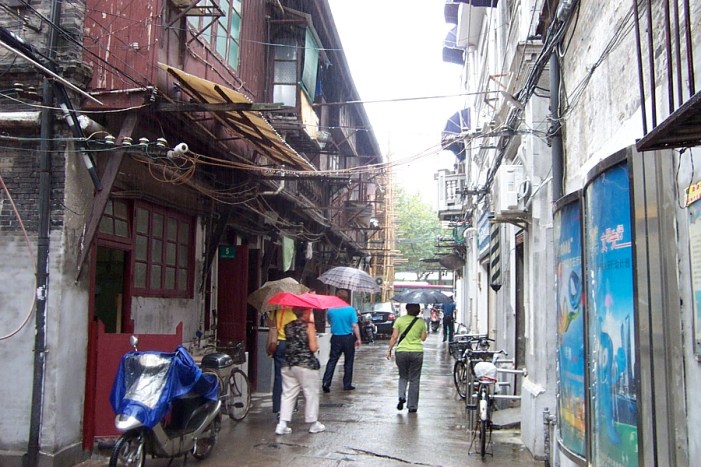
It’s a rainy Monday in Shanghai. We were lucky to get invited on a special tour by our friend Patrick, a tour of historic Shanghai that Patrick built around the life story of Mrs. X, who is our fellow traveler for the day. She is an American citizen of Russian descent who was born in Shanghai in 1940. Patrick led us to the buildings where she lived as a child, the private french school she attended, and other important historic landmarks. It was a fascinating day, made vibrant by Patrick’s extensive knowledge of Shanghai history and Mrs. X herself telling us memories of her childhood.
So much of Shanghai has changed in the past 60 years; Mrs. X was a 10 year old girl when her family fled Shanghai in 1949.

Eric and Eric and I ended the day with a delicious hot pot dinner at a neighborhood spot.

Sunday night Eric Lee insisted that we take him to the Sichuan restaurant that we had been raving about, so we did. We got the TUB of fish soup again, plus two new dishes: a stirfried tofu and pork dish, plus a wilted lettuce dish. Neither were as hot as the Sichuan green beans had been the previous night, but they were still nice and spicy and really delicious. I thought the tofu dish was especially good as it was stir-fried in chili oil and spices together with great big slices of pork belly (with the skin on) which kind of looked like the slices of tofu, but definitely did not taste like tofu. Even with three people, we still couldn’t finish the fish soup. The same young man waited on us, although he seemed preoccupied with his cell phone, so his younger sister ended up doing most of the work and was much more attentive. The check came to 101 yuan (about $15 for the three dishes and three bottles of beer), and we tried to tip the sister 10 yuan (about $1.40), and she absolutely positively would have nothing to do with that. We could NOT give her a tip. Period.
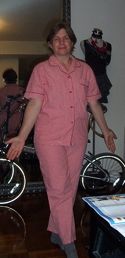
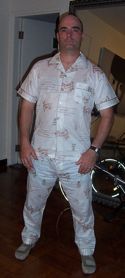 After we left the restaurant, Eric headed to the apartment while Alison and I doubled back to a clothing store we’d passed on our way to the restaurant because we’d seen that they had pajamas on display, and we wanted to buy some pajamas. Why buy pajamas? Apparently Shanghai and the Shanghailanders are famous for wearing pajamas all the time, including out on the street during the day. Plus we will be spending two nights on a train in the next few days, and it seemed appropriate to have some pajamas available to slip into for the ride.
Sure enough, the place was still open, and they had exactly the kind of pajamas we were looking for — the kind meant for locals, not the kind meant for tourists. However, the saleswoman took one look at me and shook her head when we held up the style I liked. She turned to the stacks of extra stock and found what she was looking for: the same style, but she held up the label and said, very slowly while pointing to the size: “Extra Extra Large!” I didn’t know that I was a giant, but I guess I am.
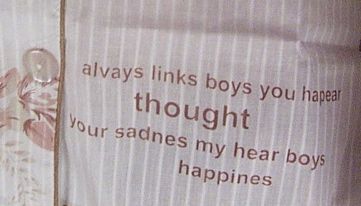
Alison did not have to get a giant size, and now we are very happy with our new pajamas, especially mine because in addition to having a very domestic design, they also exhibit the nonsense English phrases that are common on t-shirts all around the city.

We had known all along that we would join an architecture tour of the French Concession on Sunday morning, but it didn’t start until 10am so we got to spend a lazy few hours before hand eating the remainder of the melon Alison bought on Thursday, reading guide books, discussing possibilities for the afternoon, and enjoying the light gathering outside our windows.
The trip was organized by and a benefit for the Historic Shanghai association and would be led by our friend Patrick. There was such a crowd, however, that we split into two with Tina leading the second group (where we wound up). The first thing we looked at was a manhole cover with french words stamped into it — apparently a good bit of the original infrastructure still exists and is functional. The most distinctive architecture that remains from pre-1949 are some exceptional art deco houses and buildings, and Tina provided loads of stories about the architects that designed them, the families that paid for them and lived in them, and the current uses the People’s government has assigned to them.
 After the two hour tour, Eric split for a pre-arranged brunch with friends-of-friends, and Alison and I returned to the apartment to rest our feet for a bit. Then Alison left to join Eric for some art exploration, and I took off on some reconnaissance of my own. We agreed to meet on Nanxing Rd. (linking The Bund with the People’s Square), which has been transformed into a M E G A glitzy pedestrian mall at dusk. That was crazy: millions of blinking lights around hundreds of decorated store windows; loud audio “demonstrations” urging us to admire their products; thousands of people walking up and down the road along with many people aggressively wanting to hook you up with a good fake Rolex, or some fake Samsonite luggage, or something else fake of your choice. Instead of pulling up their sleeve to display ten watches, they all carried what amounted to a catalog of fake luxury items on a double-sided full color brochure. “You want a nice watch? Good price!” Whereupon they pointed to a watch among fifteen other items on the catalog page. Every sales person had the same catalog page — even the ones hanging out across town in front of the park near our apartment. I assume that they front for a store, and should we be interested, they would drag us back to the store whereupon they collect a commission, either when we arrive or when we buy something. I never did test my assumption.
Instead we walked along with everyone else, drifting through the commercial haze like tiny motes of dust in the path of a spotlight.


After dumplings and an interesting visit to a suit maker (Eric Lee is in the market for something custom), we decided we had just enough time to hop on the Metro and see Pudong. Nominally that’s the entire east side of the river, but it essentially refers to the knob of shoreline across from The Bund that’s sprouting skyscrapers like mushrooms in Maine this past summer.

Metro Line 1 to Metro Line 2 through the People’s Square station (flowing in an absolute river of humanity), then just two stops on Metro Line 2 and you emerge in a construction site surrounded by a forest of skyscrapers.
 You are also surrounded by construction walls (inevitably covered in posters for “Expo 2010”, usually featuring (besides their doughy mascot) the faces of Yao Ming, Lang Lang (pianist), and a third guy who I think is a race car driver), around which you must navigate through a maze of detours and construction equipment to get to a street or a building, much less find a news stand or a food store (good luck). This neighborhood is all about glass and steel, and the people on the street are here to see that and have their pictures taken in front of it, or possibly to work in it, but they’re not here to live, at least not to live lives we would recognize.
Continue reading “Ring-A-Ding-A-Pudong”

Eric Lee biked all over central Shanghai while we were shopping at the Market; needless to say he worked up quite an appetite, so we took Eric north of our apartment to the string of street food shops we’d been using to get breakfast bao and tofu in hot sauce. One of the stands had an empty table, so we ducked in and ordered “jiaozi” — dumplings — and two “pijiu” — beers — for a quick and satisfying lunch. 21 Yuan = $3.

Patrick and Tina invited us to go shopping with them at their local “wet market” where we could stock up on supplies for a meal or two. We met in front of a park across the street from the US Consulate where a group of women were doing their tai chi exercises, and a group of men were selling local specialty roots and shoots from the back of a mini-scooter. On to the market where we ate a few of the local Shanghai bao dumplings fresh off the grill, then explored a two story market building, from preserved meats and eggs, through fresh fish, vegetables, noodles, dried fruits and spices, and more. So much more that it would be ridiculous to post all of my pictures here, therefore you’ll have to visit my Picasa album to see them all.

Patrick picked us up in a taxi at 6:30pm and we were off on a wild rodeo ride through the Friday night streets of Shanghai. We inched and bucked our way toward The Bund, Patrick explained that the word was not English or German, but from the Urdu term for “embankment.” It is, simply, a collection of architectural piles on the western bank of the Huanpu River, a famous symbol of the city as well as a trenchant reminder of it’s colonial past.
But we had come not to look at The Bund, but to look from The Bund, specifically from M On The Bund, at the symbols of the new Shanghai: skyscrapers featuring light shows, and haute western cuisine. The scenery from the balcony overlooking the Huangpu on this warm and breezy September night was amazing, and the food more than matched it.
Continue reading “M on the Bund”

We decided to explore the city’s transit network today, and to meet Eric’s plane at the airport in the process. This meant hopping on the Metro, changing lines, crossing under the river over to Pudong, then transferring to the Mag Lev train that rockets out to the Pudong International Airport.
Patrick had warned us that the signage in the subway system might be a challenge because the line colors are not consistent, but we followed the line numbers up escalators, down stairs, and around corners, and we successfully negotiated through the People’s Square station from Line 1 to Line 2. Line 2 took us seven stops east, just beond the Zhenliang Hi-Tech Park South to Longyiang Rd. South where we exited, crossed a small lane, then went up to the Maglev station to catch the train to the airport.

And by “Maglev” they mean “Magnetic Levitation” which means the trains do not roll on wheels, rather they float above magnetized tracks, and this allows them to reach very high speeds with little resistance. And high speeds we did reach — over 430 kph (almost 300 mph) — allowing us to reach the airport 20 miles away in just about five minutes. The speed was apparent but not palpable until a maglev train passed us going the opposite direction, which almost felt like a small explosion because suddenly the window was filled with a dark blur, our train jerked toward the blur, there was a loud “whomp”, and then it was gone and we continued on our way.
 RectorSite