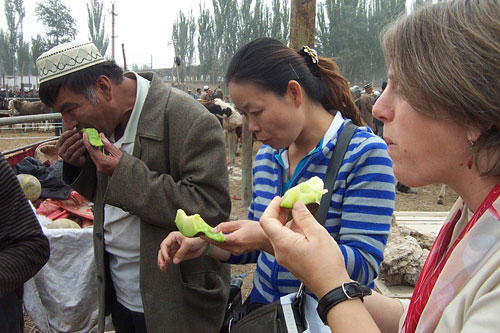
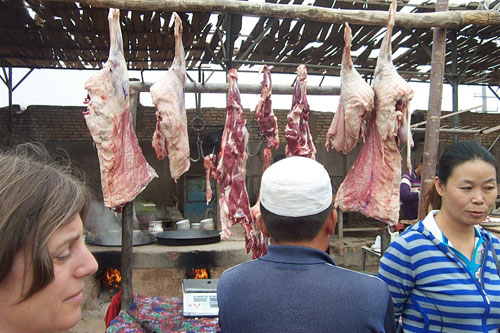
We enjoyed the sights, smells, sounds and people of the Kashgar Sunday Market. Kashgar is as far away from an ocean as any place on the planet, and just down the road (about 100km) from Pakistan.

Category: food
Doorstep To The Moon

Before we traveled to China, I used to tell people that the most “exotic” place I had ever visited was Israel and the Sinai desert because, although there were familiar elements (especially in Israel), I really felt we were on the doorstep of Asia and another way of living from what I knew. I looked forward to visiting China to finally step across that threshold and begin to understand another culture. Shanghai, despite it’s sky scrapers and fast food restaurants, granted my wish, and more. But more than two thousand miles later I felt on the edge of yet another threshold, to what I could not imagine, yet something was palpably *there* beyond what I had already learned about China in our short stay. Am I that far removed, I thought to myself, from understanding how large portions of mankind live? If so, how do I best describe Kashgar?
First, it is in the center of Central Asia : at the western edge of China where Xinjiang Province meets Kazakhstan, Tajikistan, Kyrgyzstan, Uzbekistan, Afghanistan, Pakistan, and the Kashmir region still being fought over by Pakistan and India. It’s as close to the Mediterranean Sea as it is to Beijing. It’s an ancient Silk Route trading post on the western edge of the Taklamakan Desert that separates it from the rest of Xinjiang Province where travelers stopped to prepare for their dangerous trek around this most forbidding obstacle separating the riches of the West from those of the East, or where they stopped to celebrate a successful crossing from the East. It retains the spirit of being an important hub where the world comes to buy, sell, and barter. The city’s graphic symbol is the pomegranate tree, and it’s a wellspring of the Uighur culture where they still make important Uighur products — knives, water kettles, lace hats, string instruments, silk fabrics — by hand, and grow and process much of their favorite foods in the surrounding small farms where 90% of the 3.5 million residents of the Kashgar prefecture live. While Turpan showed some direct Han influence on the Uighur people, the only recognizably Han part of Kashgar was a giant statue of Mao overlooking the main square.
We arrived with little knowledge of the city, only snippets (a *fascinating/hilarious* link!) that we had read about on the web, and the bare list of sites we would visit in our trip itinerary. Most of what we knew about the area came from “Beyond The Great Wall” where Duguid and Alford mention it only as a jumping-off point for their bike ride (!) to Pakistan via the newly opened Karakorum Highway linking Kashgar to Islamabad. The one recurring note was that we must visit the Kashgar Sunday Market…
Continue reading “Doorstep To The Moon”
Raisins In The Sun, 2

Chapter 2
(Go to Chapter 1)
 The next morning we met Ahmad and Mr. Chou at the breakfast buffet (Ahmad had melon, Mr. Chou a bowl of “gruel”), then checked out of our hotel on schedule at 9am and piled into the minivan. “After dinner Mr. Chou spent two hours last night in line at the only open gas station in Turpan right now,” Ahmad explained. “This is one more thing that frustrates me: Xinjiang provides China with 35% of it’s oil and natural gas, and yet the people of Xinjiang benefit very little from it.”
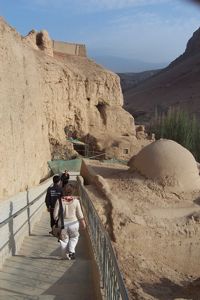
We turned onto the main highway and headed east away from Turpan back into the desert with the Flaming Mountains to our left glowing in the early morning sun. Half an hour later we turned left and headed into gap in the mountains, winding our way up the back sides until we stopped in a newly built but empty parking lot. We were handed tickets, presented them to bored attendants (who had been playing basketball when we pulled up), went through the turnstiles (“Sheh sheh.”) and then followed Ahmad down a stairway. After descending for a few minutes we came around a sharp turn and saw a series of caves up and down the hillside with stairs leading to each one from a main plaza.
Continue reading “Raisins In The Sun, 2”
Raisins In The Sun, 1
(Click here to see our Picasa album of this story.)
Dawn was late.
We woke at 7am in the Huozhou Turpan hotel (“four star!” according to our tour guide) and it was still dark out, barely a hint of light in the eastern sky, where the sun didn’t appear until 8am. Our room overlooked the only lake in the Turpan region, an artificial pond surrounded by cement in a park in the center of the city. Dominating the skyline across the pond was the Tuha Petroleum Hotel, the only “five star” hotel in Turpan, and also the offices of the region’s largest commercial employer Sinopec.
 Our room was pretty nice despite the rock hard beds (like barely padded plywood on top of some springs); it would compare well with any quality hotel room in the US, which thankfully meant a western pedestal toilet. (I think “four star” really means “private bathroom with shower and pedestal toilet.”) The buffet breakfast was Han Chinese — corn porridge (labeled “Gruel”), stir-fried vegetables and/or noodles, bao buns, and lots of sliced fruit — disappointing only because we had loved the Uygar dinner last night and looked forward to more of it. But that would come.
Continue reading “Raisins In The Sun, 1”
Last Shanghai Morning

Eric left for Beijing earlier this morning (Wed) but not before going out to get some bao, sesame rolls, and shumei for breakfast along with a couple of glasses of soy milk.
A Meal To Remember
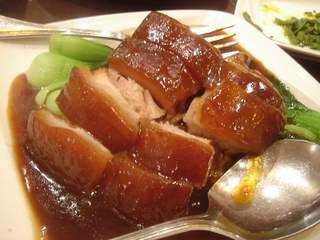 At 99 Fuxing Lu (an older restored home in the French Concession now offering “true” Shanghai cuisine); following is the menu with some translation help from our friend Patrick who set it up:
- River Eels with Asparagus
- Drunken Chicken (Zuiji in Mandarin, stewed chicken over ice)
- Kaofu in Sauce (Kaofu, braised wheat gluten with wood ear mushrooms and “golden needles”)
- Fried Smoked Blue Fish (Xunyu, but not the blue fish we know in America, more like a firm white fish)
- Braised River Shrimp (He Xia, braised in a very light sauce and served by themselves)
- Stir-fried Greens (Mixian)
- Red-cooked Pork (Hong Shao Rou, Braised Pork Belly or Pork Leg, ours was the belly)
- Eels in Brown Sauce
- Braised Shad (this could have been a true Shad, and the fish was cooked qing zhen, or steamed with ginger, scallion and a sauce of oil, soy, sugar and shaoxing wine)
- Fish Stomach Soup (Lao Ji Tang, chicken soup with fish stomach and winter melon)
- Lions Head (a light but large pork meatball, ours was served in a broth, but it’s never called soup because it can be served in a variety of context)
- Noodles with Fried Chives and Dried Shrimp
- Fermented Rice with Black Sesame Dumplings (Niang Mi Zhima Tang Yuan)
- Fruit (Shuiguo, we had watermelon – Xigua)
Breakfast in Flip Flops


Noodles with a fried egg, tofu and veg, and a bit of tea egg broth.

Monday Memories
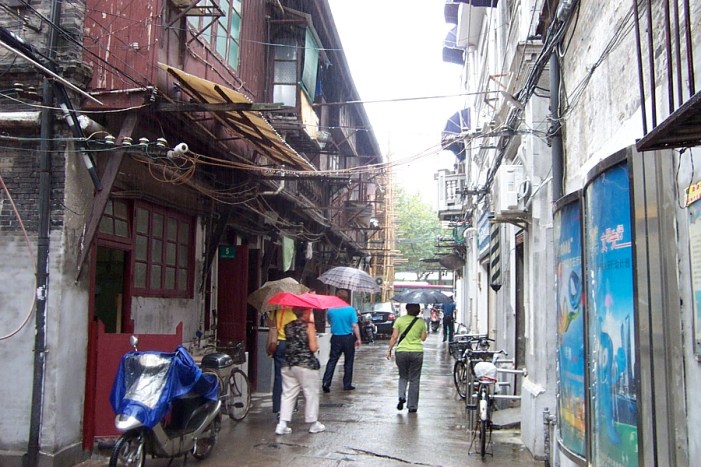
It’s a rainy Monday in Shanghai. We were lucky to get invited on a special tour by our friend Patrick, a tour of historic Shanghai that Patrick built around the life story of Mrs. X, who is our fellow traveler for the day. She is an American citizen of Russian descent who was born in Shanghai in 1940. Patrick led us to the buildings where she lived as a child, the private french school she attended, and other important historic landmarks. It was a fascinating day, made vibrant by Patrick’s extensive knowledge of Shanghai history and Mrs. X herself telling us memories of her childhood.
So much of Shanghai has changed in the past 60 years; Mrs. X was a 10 year old girl when her family fled Shanghai in 1949.

Eric and Eric and I ended the day with a delicious hot pot dinner at a neighborhood spot.

Pajama Madness
Sunday night Eric Lee insisted that we take him to the Sichuan restaurant that we had been raving about, so we did. We got the TUB of fish soup again, plus two new dishes: a stirfried tofu and pork dish, plus a wilted lettuce dish. Neither were as hot as the Sichuan green beans had been the previous night, but they were still nice and spicy and really delicious. I thought the tofu dish was especially good as it was stir-fried in chili oil and spices together with great big slices of pork belly (with the skin on) which kind of looked like the slices of tofu, but definitely did not taste like tofu. Even with three people, we still couldn’t finish the fish soup. The same young man waited on us, although he seemed preoccupied with his cell phone, so his younger sister ended up doing most of the work and was much more attentive. The check came to 101 yuan (about $15 for the three dishes and three bottles of beer), and we tried to tip the sister 10 yuan (about $1.40), and she absolutely positively would have nothing to do with that. We could NOT give her a tip. Period.

 After we left the restaurant, Eric headed to the apartment while Alison and I doubled back to a clothing store we’d passed on our way to the restaurant because we’d seen that they had pajamas on display, and we wanted to buy some pajamas. Why buy pajamas? Apparently Shanghai and the Shanghailanders are famous for wearing pajamas all the time, including out on the street during the day. Plus we will be spending two nights on a train in the next few days, and it seemed appropriate to have some pajamas available to slip into for the ride.
Sure enough, the place was still open, and they had exactly the kind of pajamas we were looking for — the kind meant for locals, not the kind meant for tourists. However, the saleswoman took one look at me and shook her head when we held up the style I liked. She turned to the stacks of extra stock and found what she was looking for: the same style, but she held up the label and said, very slowly while pointing to the size: “Extra Extra Large!” I didn’t know that I was a giant, but I guess I am.
Alison did not have to get a giant size, and now we are very happy with our new pajamas, especially mine because in addition to having a very domestic design, they also exhibit the nonsense English phrases that are common on t-shirts all around the city.

Quick Lunch

Eric Lee biked all over central Shanghai while we were shopping at the Market; needless to say he worked up quite an appetite, so we took Eric north of our apartment to the string of street food shops we’d been using to get breakfast bao and tofu in hot sauce. One of the stands had an empty table, so we ducked in and ordered “jiaozi” — dumplings — and two “pijiu” — beers — for a quick and satisfying lunch. 21 Yuan = $3.
 RectorSite
