Zidane

zidane_feet_web.jpg

We saw Zidane at the Yerba Buena Center for the Arts Screening Room last night. The room is not large, maybe 200 seats, and was packed, largely with soccer teams and their coaches. We were two of a few “civilians.”

I expected to see the familiar number 10 of the French national team, and of course, the famous head butt. But no, seventeen cameras focus on Zinedine Zidane for an entire, regular season soccer match, Real Madrid vs. Villareal, April 23, 2005. Zidane wears number 5 for Real Madrid.

This is an amazing film. For me, it defines the art of the motion picture. IMDb mentioned it as a “conceptual art installation.”
zidane-head-web.jpg
What we see on the big screen is Zidane; his face, his head, the back of his neck, his torso, his feet, sometimes his whole body. He stands, jogs, runs, handles the ball, whatever the match situation calls for. He sweats, spits, blows his nose, says very little. His expression rarely changes. We see Zidane assist on a goal as he kicks the ball across the face of the goal, to be scored on a header by a teammate. It is one of the few instances where the camera follows the ball. We see a few brief shots of a black and white video monitor and a few brief shots from the stadium roof, otherwise we don”t see the match, just Zidane. From time to time, quotes from Zidane interviews are shown as subtitles.

The film is in real time, and at half-time, news clips of things going on in the world on that day, are shown.

The sound may be even more amazing. We hear in turn, silence, the roar of maybe 80,000 rabid soccer fans, the thunk of his foot against the ball, the skidding sound of the ball on the turf, footsteps digging in the turf, a musical monotone building and fading as the action warrants.

I found the film a joy; I delighted in the clarity of the pictures moving before me. I felt as if I were in a photo gallery, passing from one photograph to the next, always thrilled by the image at hand. I was mesmerized. Carol was bored silly.

Zidane played at Sundance last year, but has not secured distribution in the US.

Here is a review from the Guardian, and a Wired review from Sundance.

zidane_torso_web.jpg

In Bruges, 4 months…

Thanks to the San Francisco Film Society, Carol and I just saw 2 outstanding films in two days and they couldn”t have been more different.

Below are plot summaries of each and there are compelling reviews of each on the internet. I will simply say see them when you can.

4months.jpg

We saw 4 Months, 3 Weeks and 2 Days in the Dolby Screening Room, and the room was an experience in itself. It’s in a renovated brick industrial building South of Market, exquisitely detailed with oak in a crisp art deco style. It seats about 120 in individual armchairs, and since the chairs are large, the room is big enough for a full blown screen. We formed an intimate relationship with the characters during the film and it was a privilege to see it in such a venue.

The New York Times synopsis:
In “4 Months, 3 Weeks and 2 Days,” a ferocious, unsentimental, often brilliantly directed film about a young woman who helps a friend secure an abortion, the camera doesn”t follow the action, it expresses consciousness itself. This consciousness — alert to the world and insistently alive — is embodied by a young university student who, one wintry day in the late 1980s, helps her roommate with an abortion in Ceausescu’s Romania when such procedures were illegal, not uncommon and too often fatal. It’s a pitiless, violent story that in its telling becomes a haunting and haunted intellectual and aesthetic achievement. “4 Months” deserves to be seen by the largest audience possible, partly because it offers a welcome alternative to the coy, trivializing attitude toward abortion now in vogue in American fiction films, but largely because it marks the emergence of an important new talent in the Romanian writer and director Cristian Mungiu. — Manohla Dargis, The New York Times

in_bruges.jpg

In Bruges

The Film Society held a special screening of Martin McDonagh‘s new film IN BRUGES at Landmark’s Embarcadero Center Cinemas on Tuesday, January 29, at 7:30 pm. Martin McDonagh was in attendance and participated in a Q+A after the film.

The film follows two hit men (Colin Farrell and Brendan Gleeson) who, after a botched job, are sent on extended leave to Bruges, where they find themselves forced to interact with the townspeople in intriguing and funny ways. The feature debut from Martin McDonagh, the award-winning Irish playwright and Academy Award winner for his short Six Shooter, opened this year’s Sundance Film Festival, which described it as “deliriously funny, pointed and perverse, yet sad, thoughtful and infused with a moral vision that resonantly reflects today’s surreal world.” The film opens in the Bay Area on February 9.

Magnificently Strange

twbb7.jpg Paul Thomas Anderson’s sprawling—yet austere—film SEEMS to be an epic masterpiece. But as the final credits rolled and I filed out of the theater, I was confused. Was it in fact a masterpiece? Or was I reacting to the incredible hype that preceded the film’s opening? Reflecting on it now, I realize it was both.
twbb4.jpgThe story goes that Anderson stumbled onto a copy of Sinclair Lewis” early 20th century novel “Oil!” in a dusty London bookshop, and immediately saw it as a film. That’s a lovely bit of lore, a poetic scrap of evidence of the way a book can seduce us with something as superficial as cover art and then draw us inside toward something deeper. Anderson — who adapted the story himself — may have loved “Oil!” but some say his love for the book doesn’t burn in the picture he’s made. “There Will Be Blood” is set in California in the same period as the book; its landscape suitably bleak to elicit a time and place foreign to most of us. (The Marfa, Texas area stands in for California in this case, ironically the same area where “Giant” and “No Country” was filmed.) Cinematographer Robert Elswit succeeds in turning this world of scrubby, modest bushes and rickety oil derricks into a visual tapestry that properly sets the scrappy mood of the film.
Continue reading “Magnificently Strange”

Blade Runner: The Final Cut

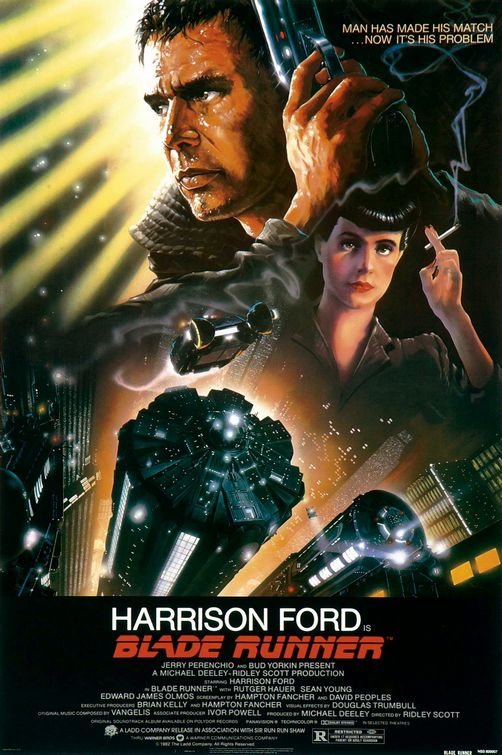
blade_runner.jpgI recently went to see a special screening of Ridley Scott’s newest version of Blade Runner, recently released as THE FINAL CUT. I am a huge fan of BR since it was released in 1982, and have the original version on both VHS and DVD. I have seen the studio release at least five times in a theatre, and countless times on video. I consider it one of my all-time favorites, though I last viewed over a decade ago.

I was excited when I saw that his “definitive” BR: FINAL CUT would be playing a limited engagement in Atlanta. I even considered watching the original again before going, but simply didn”t have the time.

As the theatre darkened (a bleak and threadbare movie house in Little Five Points that is often home to retrospectives and old horror marathons), a ball of fire erupted as the camera pulled back on a view of Los Angeles in 2019. The Vangelis soundtrack came in and my first thought was “Christ,that music is ghastly,did I actually like that stuff?” That aside,

The gravel-toned voiceover by Harrison Ford is gone (an addition that Warner Brother’s insisted upon for the hard-of-thinking). Now Rick Deckard keeps his thoughts to himself and both he and the film are infinitely more interesting for it.

This simple change creates a colder and lonelier place. Continue reading “Blade Runner: The Final Cut”

Let’s All Go To The Lobby…

lobby.jpgI think those of you who are true film buffs probably already get the IndieWire film feed, but if not, here is a link to their latest blogger’s Top 10 lists: http://www.indiewire.com/movies/2007/12/indiewires_top_3.html

These particular lists are a bit out of the mainstream (at least some of them), yet I have (for once) seen nearly ALL of the films outlined on most of the lists (the exceptions being the Sundance offerings that have yet to be released).


trans.jpg This prompts me to generate my OWN list of picks for the year:
1. “No Country for Old Men, directed by the Coen Bros

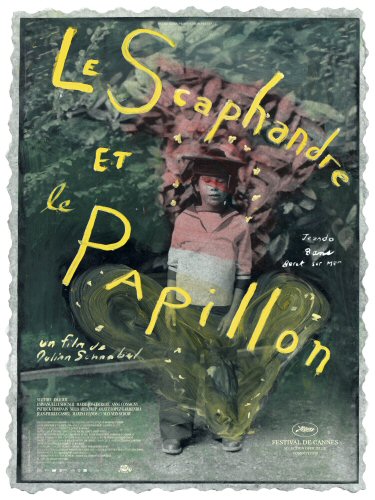
2. “The Diving Bell and the Butterfly,” directed by Julian Schnabel

3. “Into the Wild,” directed by Sean Penn

4. “Eastern Promises

5. “Lust, Caution,” directed by Ang Lee

6. “The Lives of Others,” directed by Florian Henckel von Donnersmarck

7. “La Vie en Rose

8. “Before The Devil Knows You’re Dead

9. “The Savages

10. “The Darjeeling Limited” directed by Wes Anderson

Honorable mention: Continue reading “Let’s All Go To The Lobby…”

Le Scaphandre et le Papillon

db2.jpg On the surface, the newly-released film “The Diving Bell and the Butterfly” would seem to have nothing of interest for American audiences:

  1. its about a middle-aged man at the top of his career being felled by a paralyzing stroke
  2. its in French
  3. Its subtitled
  4. it’s based on a true story
  5. It’s directed by a painter (?)

Twelve hours after seeing this film, I am still in awe. It was absolutely brilliant, and like no other film I have (perhaps) ever seen.

db3.jpgYour trusted narrator is far from an “American everyman” but I think many will find the beauty and imagination of this film to be stunning, as I did. Perhaps some of the current critical buzz will help it gain distribution that will allow more than film buffs to see it.

The short synopsis: Jean-Dominique Bauby, celebrity editor of Elle (FR) magazine, suffers a stroke at age 43; leaving him totally paralyzed,an exceeding rare occurrence called “Locked-In Syndrome”. Only his left eye is spared, so he must learn to live (and communicate) thru blinking. Continue reading “Le Scaphandre et le Papillon”

Savages

thesavages_still1.jpgKelly and I had the opportunity to see a pre-screening of THE SAVAGES with our film club last night. There has been a lot of underlying buzz for this film,I am here to say that it may be justified. Some thoughts,
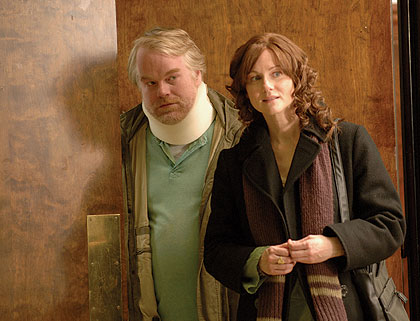
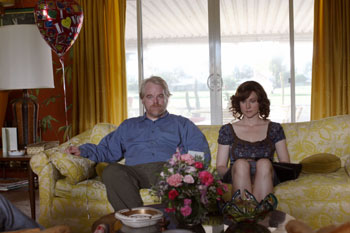
Is it really any coincidence that the two estranged Savage children are named after characters in Peter Pan? I think not. Jon (Philip Seymour Hoffman) and Wendy (Laura Linney) are middle-aged and essentially alone, having apparently successfully dodged adulthood as well as any real intimacy with another individual.

They are thrust into having to deal with their father’s sudden dementia, and the emotional and financial challenges that come with that. The potential emotional fireworks that would be seen in a Lifetime Movie of the Week are quietly dispatched in favor of the sad, absurd, and funny moments in their efforts to deal with Dad (Phillip Bosco), as well as dealing together with the past. Both Hoffman and Linney are wonderful — underplaying so perfectly to bring out the crumpled, bittersweet truths of their lives and inter-dependent relationships. Continue reading “Savages”

Three Films, Five Days

PARANOID PARK
A San Francisco
Film Society Benefit
Plus a book signing for CINEMA NOW

paranoid_park.jpg

On December 8, join us for a benefit screening of Gus Van Sant’s new film, Paranoid Park, which won the 60th Anniversary Award at the Cannes Film Festival this year. At once a dreamlike portrait of teen alienation and a boldly experimental work of film narrative, Paranoid Park finds Gus Van Sant at the height of his powers. Alex, a withdrawn high-school skateboarder (Gabe Nevins) struggles to make sense of his involvement in an accidental death: He recalls past events across tides of memory, and expresses his feelings in a diary that is, in fact, the movie we are watching. The extraordinary skating scenes, filmed by cinematographers Christopher Doyle and Rain Kathy Li in a lyrical mixture of Super 8 and 35mm, depict their subjects soaring in space, momentarily free of the earthly troubles of adolescence. The screening will take place at 7 pm at the Letterman Digital Arts Center Premiere Theatre in the Presidio. Tickets are on sale now ($12 SFFS members, $15 general). The screening will be preceded at 6:15 pm by a personal appearance of author Andrew Bailey signing copies of his new book, Cinema Now, a Taschen publication that examines the work and key themes of 60 filmmakers working around world today, from the cream of the crop of young Hollywood to the new wave of Asian mavericks to burgeoning auteurs from Europe and Latin America. Special thanks to IFC Films. [From SFFS publicity] Continue reading “Three Films, Five Days”

No Country for Old Men

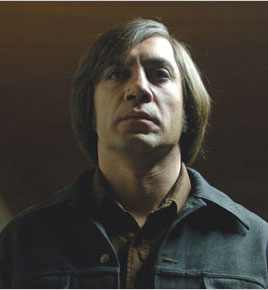
Javier Bardem in No Country For Old Men; Richard Foreman/MiramaxLast night I had the pleasure of attending an Image Film Club screening of the new Coen brother’s film “No Country for Old Men”. I highly recommend it,so for what its worth, here is a thumbnail review of my first thoughts after 12 hours of thinking about nothing else than this film,

In so many words, “creatively splattered blood within an intense triangle of characters and the study of good, not so good, and evil.” Suspenseful and uncompromising. The cinematography and art direction are amazing. Details reveal themselves in endless textures: the light over a motel at dusk, the internal glow of the highway sign tossing add hues across the parking lot. Extreme close-ups last forever, forcing you to examine not only the expression, but to trace the lines across the face and theorize where they came from and what they might mean.

The acting throughout added to the film’s excellence. Javier Bardem portrays the psychopathic killer with an intensity that grasps you tightly every time he is on screen (and even when he is not). Jones is perfect as the platitude-spouting sheriff, and Josh Brolin is totally believable as the blue collar “cowboy” who is the center of the film’s conflict. Even supporting roles are jewels to admire in their simplicity and tactile effect.

Set in Texas in the 80’s,a time frame that works because it takes you back to the place where phones had dials and were attached to walls and poles, where you had to wait for the operator to make a long distance call, and where mop-head haircuts and bell bottoms were still worn by a slice of rural America. Like Fargo, the particular phrasings of the west Texas setting make the dialog ring. “You can”t make up such a thing as that,” Sheriff Tommy Lee Jones” character declares, recalling a newspaper story of a bizarre crime in San Francisco. “I dare you to even try.” “It’s gittin” onto closing time, it is,” “You git on outa here, and don”t be thinkin” you can come back anytime soon.”

The Coens have found their way home in this incredibly memorable new film. Like Millers Crossing — and even Barton Fink — the brothers weave a simple story into a complex, thought provoking classic.

True Blue Thistle

bt_fest.jpg

On Friday night I sat at a table in a Burlington (VT) Sheraton banquet hall listening to the awards for the American Cheese Society Competition being announced. When they got to the “Blue Veined — Cows Milk” category, I was really curious to find out who won because I had tasted a lot of good blue cheese since I had arrived at the conference on Wednesday. The first cheesemaker announced, winning third place out of the 40 entries, was “Monroe Cheese Studio.”

“Whoa!” I thought, “Who else is using that name?!?!”
Continue reading “True Blue Thistle”