Tree of Life

I’d like to begin by lamenting that I missed this film when it was in the theaters.  A poor decision, as it turned out.  The cinematography is stunning. I can only imagine what its like to see it in a first-class digital theatre.

Likwise the art direction.  The narrative parts of the story put you back into growing up in the barefoot 50’s, with aluminum tumblers, dark wood floors, less-than-perfect grass (think back…did you call it a lawn then?), and playing cards in the spokes. His interiors are pitch-perfect, with the furniture we all recall from our childhood. The lighting evokes an Edward Hopper painting.

I’m trying to imagine how Terrence Malick even conceived of this film. The centerpiece narrative isn’t that unusual. Brad Pit and Jessica Chastain reflect parenthood in the time, and the struggles they endure are fairly typical. But the surrounding visuals depicting both space and time are reminiscent of the odd sidebars in 2001: A Space Oddessey. But in a good way: I have no idea what they were meant to represent, but without them the context sought would have been missing.

Emotionally the film grabs you by the collar and smashes your face to the concrete in the first ten minutes. A tragedy befalls the main characters so soon in the film that we are still unfamiliar with who they are, and yet the event had me blubbering like a little girl when it happened.  Spiraling down from there, it soon takes you on a soaring esoteric visual trip that astounds the spirit and helps you forget what just happened in the storyline.  This happens again and again throughout.

The basic story chronicles a family of three boys, with the oldest Jack, struggling to deal with his relationship with his father. Sean Penn appears occasionally as the adult Jack, still struggling with his memory of that time. Birth, death, and all in between is Malick’s canvas. Even an afterlife.

Quoting A.O. Scott from the NY TImes:
There are very few films I can think of that convey the changing interior weather of a child’s mind with such fidelity and sensitivity. Nor are there many that penetrate so deeply into the currents of feeling that bind and separate the members of a family. So much is conveyed — about the tension and tenderness within the O’Brien marriage, about the frustrations that dent their happiness, about the volatility of the bonds between siblings — but without any of the usual architecture of dramatic exposition. One shot flows into another, whispered voice-over displaces dialogue, and an almost perfect domestic narrative takes shape, anchored in three extraordinarily graceful performances: Mr. Pitt, Ms. Chastain and, above all, Hunter McCracken, a first-timer who brings us inside young Jack’s restless, itching skin.

What did it all mean? I have no idea, and yet it is very clear to me. So much so that I’m going to watch it again right now. And pray that after the Oscars it comes back into the theaters so I can experience it the way it was intended.

Condescender

Some useful passive aggressive condescending phrases.  Handy for all occasions.

1. Thank you. We’re all refreshed and challenged by your unique point of view.

2. The fact that no one understands you doesn’t mean you’re an artist.

3. I don’t know what your problem is, but I’ll bet it’s hard to pronounce.

4. Any connection between your reality and mine is purely coincidental.

5. I have plenty of talent and vision. I just don’t care.

6. I like you. You remind me of when I was young and stupid.

7. What am I? Flypaper for freaks?

8. I’m not being rude. You’re just insignificant.

9. I’m already visualizing the duct tape over your mouth.

10. I will always cherish the initial misconceptions I had about you.

11. It’s a thankless job, but I’ve got a lot of Karma to burn off.

12. Yes, I am an agent of Satan, but my duties are largely ceremonial.

13. No, my powers can only be used for good.

14. How about never? Is never good for you?

15. I’m really easy to get along with once you people learn to worship me.

16. You sound reasonable…Time to up my medication.

17. I’ll try being nicer if you’ll try being smarter.

18. I’m out of my mind, but feel free to leave a message…

19. I don’t work here. I’m a consultant.

20. Who me? I just wander from room to room.

21. My toys! My toys! I can’t do this job without my toys!

22. It might look like I’m doing nothing, but at the cellular level I’m really quite busy.

23. At least I have a positive attitude about my destructive habits.

24. You are validating my inherent mistrust of strangers.

25. I see you’ve set aside this special time to humiliate yourself in public.

26. Someday, we’ll look back on this, laugh nervously and change the subject.

Turning 40

Important events in the year 1972 which changed the world, and still resonate today.  In celebration of my first son Matthew Thomas Rector’s birthday…today.

political events
President Nixon arrives at Beijing (Peking) February 20 with his national security adviser Henry A. Kissinger to confer with Chairman Mao Zedong (Mao Tse-tung) and Premier Zhou Enlai (Chou En-lai), ending the U.S. hostility toward the People’s Republic of China (PRC) that has persisted since 1949.

FBI director J. Edgar Hoover dies at Washington, D.C., May 2 at age 77. He directed the bureau for 48 years, being allowed to remain in office through special presidential dispensation despite rumors that he is a cross-dresser who holds power by keeping files on the indiscretions of leading politicians, including heads of state.

Congresswoman Bella Abzug (D. N.Y.) introduces a resolution May 9 calling for the impeachment of President Nixon following his decision to mine North Vietnamese harbors.

President Nixon arrives at Moscow May 22 and confers with Party Secretary Leonid Brezhnev in the first visit of a U.S. president to the Soviet Union since 1945…
Continue reading “Turning 40”

THE SUBMISSION (a book review)

Amy Waldman began her book The Submission long before the “Ground Zero Mosque” or the recent controversy about “American Muslim” .  From that perspective, its frustrating to realize that over ten years after 9/11, many American’s litmus test for legitimacy is its (real, imagined, or contrived) connection with Islam.
Set in 2003, the commission charged with selecting the final design of the site memorial settles upon a garden design submitted by a young architect whose name alone sparks vitriol. An American born of Indian parents, his prominence in his field cannot overcome the fact that he has the most Islamic of Islamic names: Mohammad. That factor alone, exacerbated by the media and reactionary factions, turns this somber effort into a vitriolic debate on who should be permitted to suggest an appropriate symbol of America’s darkest and most violent event in recent history.

Politics, religious exceptionalism, history, immigration, and jihadi myth all play out in the story as it careens through toward what will surely be a LOSE-LOSE conclusion. An unexpected event spins the story into an obvious — yet unexpected — conclusion.

The writer further appends an epilogue which takes us twenty years in the future to imagine the longer-term outcome of the decisions made in the heat of the moment. This device, initially striking me as a bit polyannaish in its optimism for the future, upon further reflection seemed a hopeful possibility.

The book overall was a timely and well-written commentary on what is and what can be.

If you are in a book club, recommend this as a future selection. The themes contained will provide for a lively discussion.

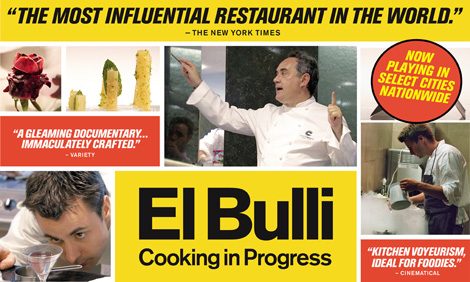
El Bulli: Cooking in Progress

Embarcadero November 17, 2011, a guilty pleasure, film in the afternoon.


Renowned Spanish chef Ferran Adrià is widely considered the best, most innovative and craziest chef in the world. In his kitchen, that which was once familiar disintegrates. Each year his restaurant El Bulli closes for half a year—time for Adrià and his team to retire to his Barcelona cooking laboratory to create the new menu for the coming season. Filmmaker Gereon Wetzel closely observes their quest—from initial experimentation to the premiere of the finished dish. In the course of that process, however, many an ingredient is examined in a totally new way. Taste and texture are systematically analyzed: by boiling, roasting, frying, steaming—vacuumizing, spherifying, freeze-drying—and then, tasting. Ideas emerge, are discussed and, finally, all the results, whether good or bad, are thoroughly documented—on a laptop beside the cooking spoon. Anything goes—except copying oneself. An elegant, detailed study of food as avant-garde art, El Bulli: Cooking In Progress is a tasty peek at some of the world’s most innovative and exciting cooking; as Adrià himself puts it, “the more bewilderment, the better!” (Fully subtitled)
Director: Gereon Wetzel
Cast: Ferran Adrià, Oriol Castro, Eduard Xatruch, Eugeni de Diego, Aitor Lozano


ABOUT THE RESTAURANT

Revolutionary Spanish eatery El Bulli is a Michelin three-star restaurant in Roses, Spain (two hours northeast of Barcelona); each night, it serves a tasting menu of 30+ courses, prepared by over 40 chefs, to a single seating of up to 50 guests. For the current season, its last before transforming into a culinary academy, over two million requests were received for the 8,000 available seats. Head chef Ferran Adrià, who took over the restaurant in 1987 and instituted the tradition of yearly developmental sabbaticals, has become the leading inspiration for avant-garde cuisine worldwide, alternately referred to as a mad scientist or Salvador Dali of the kitchen.

ravioli

MY TAKE – This was good and engaging and very well presented; but to me, this wasn’t about El Bulli or about food, it was about research, development and presentation of a product… it happens to be food in this case. But the product doesn’t look like food, one doesn’t lick ones chops at the preparation or presentation of the food… the only reason I was hungry when I left – it was almost dinnertime. There is plenty of Ferran Adria and his top chefs tasting things and words like “brilliant” “exciting” “magic” “bewilderment” and Ferran once admonishes a chef, “This doesn’t taste good. Never bring me anything that doesn’t taste good.”
As for El Bulli, there are gorgeous pictures of the restaurant and the setting, but never the dining room, never patrons enjoying their meal. I was interested in how “china” is selected/created for each dish, but not a word about that. At the end, the camera focused on Adria as he was served each dish in the sequence it will be (is being?) served to the diners.
Would that we could have experienced touch (since many of the courses are eaten with one’s fingers) and taste and smell.
It’s like a long and critical and loving study of a woman’s face and makeup and skin care, but at the end, you know nothing about the woman, except that her face is quite beautiful and she lives in a fabulous house on the Mediterranean.

“For a foodie, the new film about Spain’s renowned El Bulli restaurant is a bit like an Angelina Jolie movie for a teenage boy… Food lovers can now salivate via celluloid. El Bulli: Cooking in Progress, a meticulous exploration of how this famously avant-garde eatery comes up with its insanely inventive creations…for those passionate about the artistry and indeed the science of cooking, it’s dangerously close to porn. There are some unintentionally very funny moments, like when two chefs go to the local market and ask for five single grapes for their testing – and three beans”

– Jocelyn Noveck, Associated Press

Salted Caramel Cheesecake Bars

Masha just made these for our Thanksgiving dessert.

Salted Caramel Cheesecake Bars
adapted from Chewy Gooey Crispy Crunchy by Alice Medrich

Crust
14 tablespoons unsalted butter, melted and still warm
1/2 cup (3.5 oz) sugar
2 teaspoons vanilla extract
3/8 teaspoon salt
2 cups (9 oz) all-purpose flour

Filling
1/2 cup caramel sauce (recipe below) (or use store bought)
1 1/2 lbs cream cheese, at room temperature
1/4 cup (1.75 oz) sugar
1 1/2 teaspoons vanilla extract
2 large eggs, at room temperature

To make the crust: Preheat oven to 350 F with a rack in the lower third of the oven.  Line a 13×9 baking pan with foil, leaving an overhang so you can lift the bars out after they’ve baked.  Spray the foil with nonstick cooking spray.

Combine the melted butter, sugar, vanilla and salt in a medium bowl.  Stir in the flour until just incorporated – the mixture will be soft, that’s fine.  Transfer the mixture to the prepared baking pan and press into an even layer on the bottom of the pan.  Bake for 20-25 minutes, or until the crust is golden brown.  Let cool completely.  Turn the oven down to 325 F.

In the bowl of a stand mixer fitted with the paddle attachment, beat the cream cheese on medium speed until smooth, about 30 seconds.  Scrape down the sides of the bowl then add the sugar and vanilla, beating until smooth and creamy, about 1-2 minutes.  Add the eggs, one at a time, beating just until incorporated and scraping down the sides of the bowl in between.  Transfer 2 tablespoons of this batter to the 1/2 cup of caramel sauce and stir to incorporate.  Pour the remaining cheesecake batter over the cooled crust and spread evenly.

Dollop the caramel sauce mixture over the filling (I didn’t end up using all of the caramel).  Use a toothpick to gently marble the caramel – be careful not to scrape the crust while you are doing it.  Bake for 20-25 minutes, or until the edges are puffed and the center is just barely set.

Transfer the pan to a cooling rack and let come to room temperature.  Cover and refrigerate for at least 4 hours, but preferably 24.  Use the foil sling to lift the bars out of the pan and transfer to a cutting board.  Cut into squares with a long sharp knife.  The bars can be refrigerated in an airtight container for up to 4 days.

Salted Caramel Sauce
adapted from Cook’s Illustrated

2 cups sugar
1 cup heavy cream
2 tablespoons cold unsalted butter
1 teaspoon grey sea salt

Add 1 cup of water to a 2-qt saucepan.  Gently add the sugar to the center of the pot – it will mound, that’s fine.  Cover the pot and bring to a boil over high heat.  Once boiling, uncover the pot and insert a candy thermometer.  Continue cooking until the mixture registers 300 F and is just starting to develop some color, about 15 minutes.  Reduce heat under the pot to medium and cook until the syrup is amber and registers 350 F on the thermometer, about another 5 minutes.  Meanwhile, pour the cream into a small saucepan and bring to a simmer.  If it simmers before the syrup is ready, just take it off the heat and set aside.

Remove the caramel from the heat and add about 1/4 of the warm cream to the pot.  It will bubble furiously so be careful.  Once the bubbling subsides, add the remaining cream.  When it stops bubbling, whisk gently to incorporate fully.  Add the butter and the salt and whisk to combine.

Set aside 1/2 cup of the salted caramel sauce for the cheesecake bars.  The remainder can be refrigerated for up to 1 month.

Makes about 2 cups

I’ll let you know how they taste (but they look awesome!)

http://traceysculinaryadventures.blogspot.com/2011/05/salted-caramel-cheesecake-bars.html